



A dozen eggs, a gallon of milk, a loaf of bread. For the average retired worker collecting $1,976 a month from Social Security in 2026, those staples are not small purchases. They are budget decisions. And federal data from multiple agencies now confirms what millions of older Americans already sense at the checkout: grocery inflation is consuming a larger share of their fixed incomes than it does for any other age group.
January’s 2.8 percent cost-of-living adjustment, detailed in the Social Security Administration’s 2026 fact sheet, added roughly $55 a month to the average benefit. That raise was calculated using a price index designed for working-age wage earners, not retirees. The mismatch between how the government measures inflation for benefit purposes and how retirees actually spend their money is at the center of a slow, compounding erosion of purchasing power that shapes what ends up in shopping carts and what gets left on the shelf.
Retirees spend more on groceries, and the data proves it
The Bureau of Labor Statistics tracks a research price index built specifically for older Americans. Known as the R-CPI-E, it measures inflation as experienced by people 62 and older and assigns a heavier weight to food at home than the standard Consumer Price Index. The reason is not complicated: retirees cook more meals in their own kitchens and eat out less often than working-age adults.
The BLS Consumer Expenditure Survey for 2023, the most recent full-year data available, puts hard numbers behind the pattern. Households headed by adults 65 and older devote roughly 8 percent of their after-tax income to food at home, compared with about 6 percent for households under 65. The agency’s relative-importance tables reflect the same tilt, giving food at home a bigger budget share for older consumers than for the overall CPI population.
That two-percentage-point gap matters more than it sounds. Groceries are a necessity with few easy substitutes. A retiree cannot skip eggs the way a younger worker might cancel a streaming subscription. When prices rise on items you cannot do without, the squeeze is immediate.
The COLA formula was not designed for retirees
Social Security’s annual cost-of-living adjustment is pegged to the CPI for Urban Wage Earners and Clerical Workers, or CPI-W, measured from the third quarter of one year to the third quarter of the next. The SSA’s own fact sheet spells out the formula. The problem is that CPI-W tracks spending patterns of working-age wage earners, not retirees. It gives more weight to commuting costs and apparel and less weight to medical care and groceries.
When grocery prices rise faster than transportation or clothing costs, the COLA understates the inflation retirees actually experience. BLS data going back to 1982 shows the R-CPI-E has averaged roughly 0.2 percentage points higher per year than the CPI-W. That fraction sounds trivial in any single year. Over a 20-year retirement, it compounds into hundreds of dollars in lost purchasing power annually, a gap that widens the longer someone collects benefits.
Which grocery categories are driving the pressure
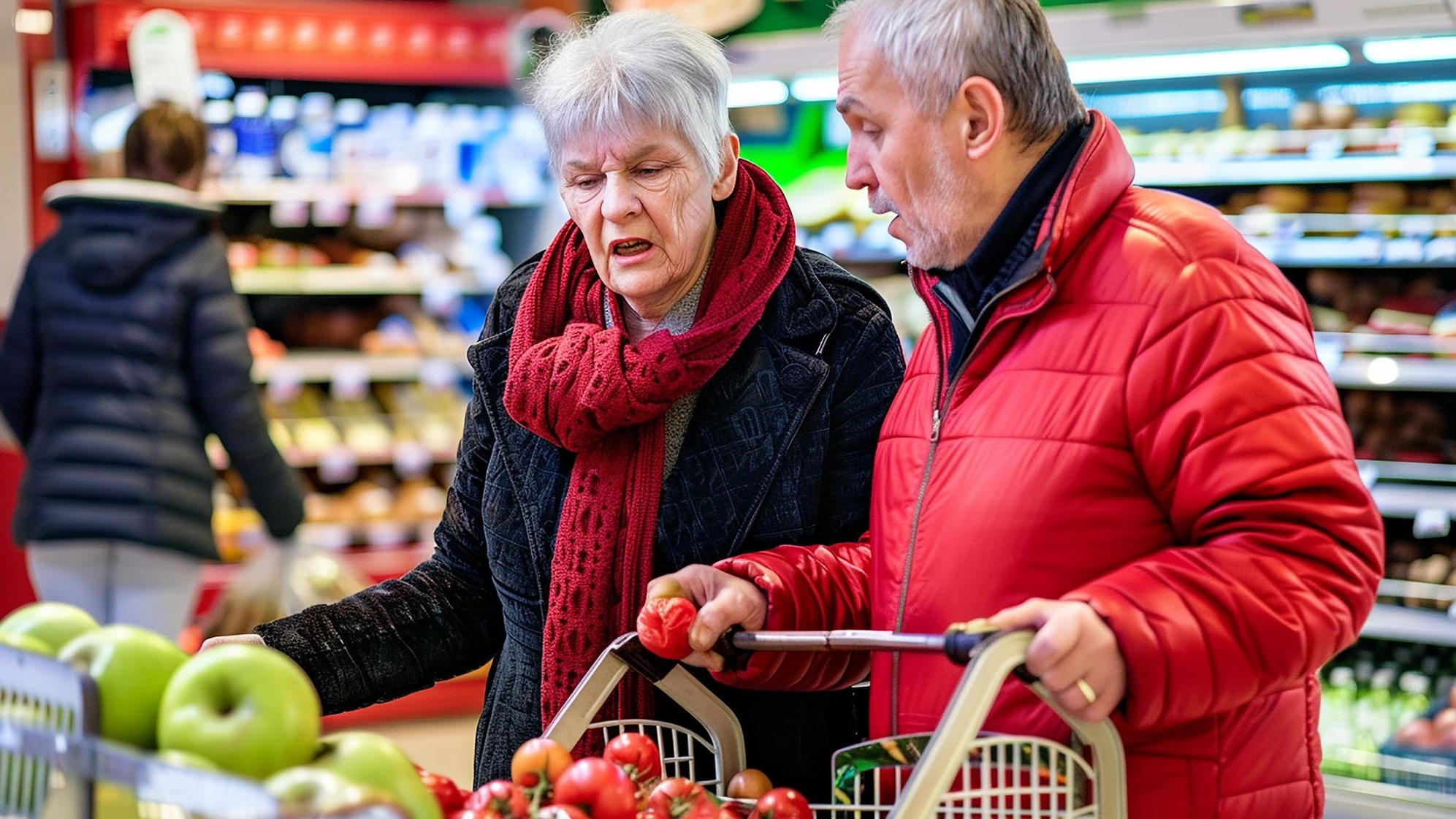
The USDA Economic Research Service maintains a regularly updated Food Price Outlook built on BLS consumer and producer price data. In its 2025-2026 forecast cycle, the agency projected food-at-home prices would rise between 1.2 and 3.7 percent, with meats, dairy, and cereals among the leading contributors. Fresh produce has seen more volatile swings tied to weather disruptions and transportation costs.
Category-level detail from the BLS CPI data portal confirms that food at home has continued to rise faster than the overall index in recent months through early 2026. Eggs, which became a flashpoint for grocery inflation after avian flu outbreaks disrupted supply chains, remain significantly more expensive than their pre-pandemic baseline. Dairy and bread prices have also stayed elevated.
Food away from home has climbed too, pushed by higher labor and rent costs in the restaurant industry. But retirees are less exposed to that category because they eat out less frequently. They shoulder a disproportionate share of the grocery increases without benefiting much from any relative moderation in dining-out prices.
Why the gap keeps compounding and what, if anything, could change
Unless Congress changes the law, Social Security benefits will continue to be adjusted using the CPI-W rather than an elderly-specific index. Lawmakers have periodically introduced legislation to switch to the R-CPI-E or a similar measure. The most recent version, the CPI-E Act, would direct BLS to publish the elderly index as an official statistic and require SSA to use it for COLA calculations. AARP has publicly endorsed that legislative approach, arguing in its policy platform that the current formula shortchanges older adults whose spending is concentrated in health care and food. None of these bills has advanced to a floor vote in recent sessions of Congress.
The federal numbers also have real limits that are worth noting. The Consumer Expenditure Survey groups all households headed by someone 65 or older together, whether that person lives on a $1,900 Social Security check or draws six figures from investment accounts. BLS does publish public-use microdata that could isolate retirees whose primary income is Social Security, but no federal agency has released a ready-made analysis doing that for the current period. The R-CPI-E itself is a research series, not an official index, and there is no published federal estimate tying grocery inflation directly to changes in retiree poverty rates. The most that current evidence supports is that rising grocery prices are one of several forces steadily eroding the purchasing power of fixed benefits.
Retirees who need help stretching their grocery budgets do have some options. The USDA’s Supplemental Nutrition Assistance Program (SNAP) serves adults over 60, and many states operate commodity distribution and congregate meal programs through local Area Agencies on Aging. Eligibility thresholds and benefit amounts vary by state. According to USDA estimates, only about 48 percent of eligible adults 60 and older actually participate in SNAP, one of the lowest uptake rates of any age group. Barriers include confusion about eligibility rules, a stigma some older adults attach to food assistance, and application processes that can require in-person visits or extensive documentation.
For now, the math is simple and unforgiving. Grocery prices climb faster than the formula used to adjust retirement benefits. The people who spend the most on food and have the least flexibility to earn more feel it first. Every trip to the store is a reminder that the cost-of-living adjustment and the actual cost of living are not the same thing.